


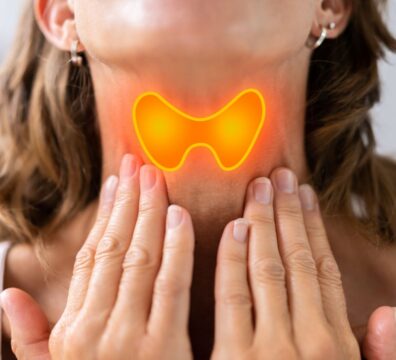
An underactive thyroid can have different underlying causes — most often either classical hypothyroidism or Hashimoto’s thyroiditis. While both conditions can affect fertility, they require different dietary approaches. In classical hypothyroidism, iodine plays a key role in hormone production. In Hashimoto’s, the focus shifts towards immune balance, antioxidant support and nutrients such as selenium. Understanding the difference can be crucial when trying to conceive.
Does this sound familiar?
In my day-to-day work with women trying to conceive, I hear this again and again:
“I’ve been told I have an underactive thyroid — but no one has ever explained what that actually means.”
And this is often where an important piece of the puzzle is missing.
Because not all thyroid conditions are the same.
And understanding the difference can make a real impact — particularly when it comes to fertility.
Why the underlying cause matters
Many women are prescribed thyroid hormones such as levothyroxine — and this is often an important first step.
However, what your body needs beyond that can be very different.
In classical hypothyroidism, the thyroid often lacks the building blocks needed to produce hormones efficiently.
In Hashimoto’s, the issue is not a shortage of raw materials, but an immune system that is attacking the thyroid itself.
And that difference changes everything.
Classical hypothyroidism – when the body lacks essential building blocks
In classical hypothyroidism, the thyroid does not produce enough hormones — often due to insufficient iodine intake.
Iodine is essential for the production of thyroid hormones T3 and T4. Without enough iodine, the thyroid simply cannot function optimally.
In the UK and across Europe, iodine intake can be borderline, especially in women who eat a very “clean” diet, avoid processed foods, or use little iodised salt.
Good dietary sources include sea fish, dairy products and eggs — but in everyday life, intake is often lower than expected.
In this situation, supporting the body with the right nutrients can make a meaningful difference. This is particularly important when trying to conceive, as the demand for thyroid hormones increases.
In my experience, many women benefit from targeted micronutrient combinations that include iodine alongside other fertility-supporting nutrients — such as those found in Fertilovit® F ou Fertilovit® F 35 plus.
Hashimoto’s – when the immune system is involved
Hashimoto’s is a very different situation.
Here, the thyroid is not simply underactive — it is affected by a chronic autoimmune process. The immune system gradually attacks the thyroid tissue, leading to inflammation and reduced function over time.
This is why a different approach is needed.
One of the most common misconceptions I encounter is around iodine. While normal dietary intake remains important, excessive iodine supplementation can potentially stimulate inflammatory processes in the thyroid.
Instead, the focus shifts towards protecting the thyroid and supporting immune balance.
Selenium plays a central role here. It helps protect thyroid tissue from oxidative stress and supports the conversion of T4 into the active hormone T3.
At the same time, liver function becomes particularly important, as this is where hormone activation takes place. Nutrients such as B vitamins, zinc, and iron all contribute to this process.
In practice, many women benefit from a targeted, iodine-free formulation that supports these pathways — for example Fertilovit® F Thy, which has been specifically developed for women with Hashimoto’s and fertility goals.
Could it be Hashimoto’s?
The challenge with Hashimoto’s is that symptoms often develop gradually and can be easy to overlook.
You might recognise some of these patterns:
You feel persistently tired, even after a full night’s sleep. You may feel unusually sensitive to cold, notice changes in your cycle, or struggle with unexplained weight gain or hair loss. Some women only begin to question their thyroid health when they face difficulties conceiving.
A key diagnostic indicator is the presence of thyroid antibodies, particularly TPO antibodies.
If you feel that something is not quite right, it is always worth asking for a more detailed assessment.
Quick Self-Test: Could it be Hashimoto’s?
This short test is not a diagnosis — but it may give you a useful indication.
Answer yes or no:
- Do you often feel tired, even after enough sleep?
- Do you feel cold more easily than others?
- Have you experienced cycle irregularities or difficulty conceiving?
- Have you been diagnosed with an underactive thyroid?
- Do you feel unwell despite “normal” lab results?
- Have you noticed hair loss or unexplained weight changes?
- Have your thyroid antibodies ever been tested?
👉Your result
If you answered “yes” to several of these questions, it may be worth exploring whether Hashimoto’s could be a contributing factor.
Why this matters for fertility
The thyroid gland influences far more than just metabolism.
It plays a central role in ovulation, egg maturation and implantation. Even when thyroid levels appear to be well controlled, this does not automatically mean that the body is being optimally supported – particularly in autoimmune conditions such as Hashimoto’s thyroiditis. In these cases, the strain affects not only the thyroid itself, but also the immune system.
This is precisely why targeted nutritional support is so important. Certain micronutrients may help support the immune system, balance inflammatory processes and provide the body with optimal nourishment during sensitive phases such as trying to conceive.
The good news is that once you understand what is happening in the body, you can take targeted steps to support it and actively help create better conditions for a healthy pregnancy.
What you can do
Many women find it reassuring to realise that there are practical steps they can take.
It is not about doing everything perfectly.
It is about focusing on what truly matters.
A balanced diet, good sleep, and managing stress form the foundation. Beyond that, targeted nutritional support can help your body where it needs it most.
And this is where the distinction becomes important:
In classical hypothyroidism, supporting iodine intake can be key.
In Hashimoto’s, the focus shifts towards selenium, antioxidant protection and supporting hormone conversion.
Bonus: Your Hashimoto & Fertility Checklist
In my work, I see how helpful it can be to have a clear structure.
That’s why I’ve created a simple checklist to guide you through the most important steps:
👉 “Am I ready for pregnancy with Hashimoto’s?”
You can download it as a printable PDF.
It helps you keep track of your lab values, identify potential gaps, and prepare more confidently for your fertility journey.
💛 👉 Download your checklist here
Final thoughts
You do not need to do everything perfectly.
But understanding your body — and what it truly needs — can make all the difference. Because sometimes, it is not about doing more.
It is about doing what is right for you.
FAQ – Thyroid, Hashimoto’s and Fertility
Not always. While iodine is essential in classical hypothyroidism, supplementation should be approached with caution in Hashimoto’s.
This can be determined through blood tests, including thyroid antibodies (particularly TPO antibodies), alongside standard thyroid markers and, if needed, ultrasound.
Selenium helps reduce oxidative stress, supports thyroid function and plays a role in hormone activation.
Yes, absolutely. With proper management and targeted support, many women conceive successfully.
Standard ranges do not always reflect optimal levels for every individual. Antibodies, nutrient status and hormone conversion can all play a role.